

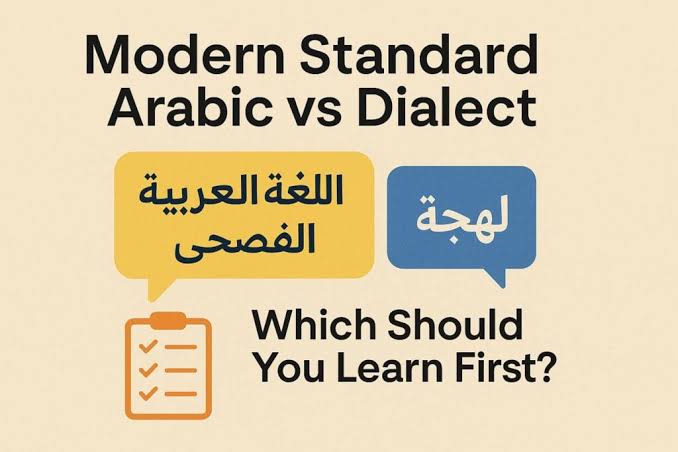
MSA vs Gulf Arabic: What Should You Learn First When Living in the UAE?
If you decide to learn Arabic while living in the UAE, one of the first questions you may face is surprisingly simple: which Arabic should you learn?
A quick search can introduce you to Modern Standard Arabic, Gulf Arabic, Emirati Arabic, Egyptian Arabic and several other varieties. For a complete beginner, that can make Arabic seem more complicated than it really needs to be.
The choice becomes easier once you focus on your reason for learning.
Do you want to read Arabic confidently? Do you want to speak with people in everyday situations? Are you learning for work? Do you want to understand signs, announcements and written communication? Or are you hoping to build a complete foundation that supports both reading and conversation?
Understanding MSA vs Gulf Arabic can help you make a much smarter decision at the beginning instead of spending months learning material that does not match your real goals.
For learners living in Dubai, Abu Dhabi or elsewhere in the UAE, the most useful approach is often not choosing one forever and ignoring the other. It is understanding what each variety does well and learning them in the right order.
What Is Modern Standard Arabic?
Modern Standard Arabic, commonly shortened to MSA, is the standardized form of Arabic used widely in formal written and spoken contexts.
You are likely to encounter it in:
- books
- news
- formal articles
- official communication
- educational material
- public information
- formal speeches
- many signs and notices
If you want to become comfortable reading Arabic, MSA gives you an important foundation.
It is also useful because learners from different Arabic-speaking countries can study the same standard written language even though their everyday spoken dialects may differ.
For beginners, MSA provides structure. You learn vocabulary, sentence patterns and grammar in a form that is widely understood.
That makes it especially valuable for long-term Arabic learning.
What Is Gulf Arabic?
Gulf Arabic generally refers to related spoken Arabic varieties used across parts of the Arabian Gulf.
You may also hear the term Khaleeji Arabic, from the Arabic word خليجي, khaleeji, meaning “Gulf-related.”
It is important to understand that Gulf Arabic is not one perfectly identical dialect spoken everywhere. Speech varies between countries, regions, communities and even generations.
In the UAE, you may hear local Emirati Arabic alongside other Gulf varieties and many other Arabic dialects because the country has such a diverse population.
Gulf Arabic is most useful when your goal is natural everyday interaction.
You may hear it in:
- greetings
- social conversations
- shops
- local workplaces
- family interactions
- everyday requests
- informal discussions
If your main goal is speaking comfortably in the UAE, exposure to Gulf-style spoken Arabic can therefore be very useful.
MSA vs Gulf Arabic: The Key Difference
The easiest way to understand the difference is this:
MSA gives you a strong formal and written foundation. Gulf Arabic helps you communicate more naturally in everyday Gulf situations.
Neither is “better” in every situation.
They simply serve different purposes.
Consider this table:
| Your Goal | Most Useful Starting Point |
| Learn to read Arabic | MSA |
| Understand formal writing | MSA |
| Follow news or formal communication | MSA |
| Speak in everyday UAE situations | Gulf Arabic exposure |
| Build a long-term Arabic foundation | MSA + spoken practice |
| Communicate socially in the Gulf | Gulf Arabic |
| Learn Arabic for work | Usually a combination |
| Become a well-rounded learner | MSA first, then structured dialect exposure |
The right choice depends on what you need Arabic to do for you.
Should Complete Beginners Start with MSA?
For many complete beginners, starting with a structured MSA foundation makes sense.
Why?
Because you first need to understand how Arabic works.
That includes:
- recognizing letters
- reading words
- understanding basic sentence patterns
- learning common vocabulary
- developing pronunciation
- building confidence
Once you have this foundation, learning spoken forms becomes easier because you have something to connect them to.
However, this does not mean you should avoid spoken Arabic until you become advanced.
A better approach is to learn useful conversational expressions from the beginning while building your formal foundation.
For example, a beginner might learn:
كيف حالك؟
kayfa ḥāluka?
How are you?
alongside more natural expressions they hear around them in daily conversation.
The important thing is understanding which form you are learning and where you are likely to use it.
What If Your Main Goal Is Speaking?
If your main goal is conversation, you should introduce spoken Arabic early.
Imagine someone living in Dubai who wants to communicate more comfortably with Arabic-speaking colleagues, customers or neighbours.
If that learner spends a year studying only formal written grammar and almost no conversation, they may know many rules but still hesitate when someone speaks naturally.
That is why speaking needs to be practised as a skill.
A conversation-focused learner should spend time on:
- greetings
- introductions
- numbers
- directions
- common questions
- polite requests
- workplace expressions
- shopping language
- listening practice
At the same time, maintaining some MSA foundation can prevent the learner from becoming dependent only on memorized phrases.
Can You Learn MSA and Gulf Arabic Together?
Yes, but beginners need organization.
Trying to learn two systems as if they were unrelated languages can create unnecessary confusion.
Instead, think of Arabic as having different registers and spoken varieties.
You might learn the MSA word or sentence first, then learn how the same idea is commonly expressed in spoken Gulf contexts.
For example, your online Arabic lessons might teach a standard form for understanding and reading while also introducing conversational alternatives when useful.
This creates a bridge between what you read and what you hear.
A Better Learning Model for UAE Residents
For many learners in the UAE, a blended model works well.
Stage 1: Build the Arabic foundation
Focus on:
- alphabet
- pronunciation
- basic reading
- high-frequency vocabulary
- simple sentence construction
Stage 2: Add everyday spoken expressions
Introduce situations such as:
- greeting people
- introducing yourself
- ordering something
- asking a price
- asking where something is
- understanding simple replies
Stage 3: Develop listening
Arabic can sound fast when you first hear natural conversation.
Regular listening helps you recognize words you already know.
Stage 4: Add Gulf vocabulary and expressions
Once your foundation is stable, begin noticing expressions commonly used in the Gulf.
Stage 5: Practise real situations
Instead of memorizing random word lists, practise conversations related to your own life.
If you work in the UAE, practise office Arabic.
If you are a parent, practise school-related vocabulary.
If you travel frequently, practise directions and transport language.
Arabic for Work: Which Form Is Better?
The answer depends on your role.
Formal written communication may require more MSA vocabulary.
Everyday workplace interaction may involve spoken Arabic.
For example, a professional could encounter Arabic in:
- government-related documents
- customer interactions
- messages
- meetings
- reception areas
- phone calls
- public announcements
Someone working primarily with documents may need stronger formal Arabic.
Someone in sales, customer service or operations may benefit more quickly from spoken communication skills.
Many professionals eventually need some of both.
What About Children Learning Arabic in the UAE?
Children benefit from clarity as well.
If Arabic is part of school learning, reading and formal language matter.
But children also benefit from hearing Arabic naturally and using simple spoken expressions.
Parents do not need to create two separate complicated programs.
A child can build:
- strong sound recognition,
- reading ability,
- age-appropriate vocabulary,
- basic sentence formation,
- conversational confidence.
The key is gradual exposure rather than overwhelming the child with dialect terminology.
Five Mistakes to Avoid
1. Waiting Until Your MSA Is “Perfect” Before Speaking
Perfection is not required before conversation starts.
Speaking should develop alongside structured study.
2. Learning Only Random Dialect Phrases
Memorized expressions help, but without a foundation it becomes difficult to create new sentences independently.
3. Treating Gulf Arabic as One Identical Dialect
Speech varies across the Gulf. Learn useful patterns without assuming everyone speaks exactly the same way.
4. Changing Dialects Constantly
A beginner who jumps between Egyptian, Levantine, Gulf and other varieties may become unnecessarily confused.
Build one clear foundation first.
5. Ignoring Your Real Goal
Someone learning for reading needs a different emphasis from someone learning mainly for customer conversations.
Your learning plan should reflect that.
A Simple 12-Week Beginner Roadmap
Weeks 1–3: Foundation
Learn:
- key letter sounds
- greetings
- basic pronouns
- numbers
- everyday nouns
Weeks 4–6: Build Simple Sentences
Practise:
- “I want…”
- “I have…”
- “Where is…?”
- “What is this?”
- “How much is this?”
Weeks 7–9: Increase Listening
Use short conversations and repeat them aloud.
Notice which expressions are formal and which are conversational.
Weeks 10–12: UAE Practice
Focus on situations you actually encounter:
- taxi
- office
- restaurant
- school
- reception
- shop
- building security
By the end of the period, the goal is not fluency. It is being able to recognize and use Arabic more confidently than when you started.
So, Which Should You Learn First?
If you are still unsure about MSA vs Gulf Arabic, use this simple rule:
Start with enough MSA to understand the structure of Arabic, but do not postpone speaking.
Add Gulf Arabic gradually when your real-life environment requires it.
This combination gives you both a foundation and practical communication ability.
Someone who learns only formal Arabic may struggle with natural conversation.
Someone who memorizes only spoken expressions may struggle to read and build new sentences.
A balanced learner develops both.
Frequently Asked Questions
Is Gulf Arabic difficult for beginners?
It does not have to be. Start with useful expressions instead of trying to master an entire dialect immediately.
Is MSA spoken in everyday UAE conversations?
Everyday conversations often use spoken varieties rather than full formal MSA. However, MSA remains highly useful for reading, education and formal contexts.
Can I learn Gulf Arabic without learning MSA?
You can learn conversational phrases, but a structured Arabic foundation usually makes long-term progress easier.
Which Arabic is best for Dubai?
It depends on your purpose. MSA helps with reading and formal language, while exposure to Gulf Arabic supports everyday regional conversation.
Should children learn MSA or Gulf Arabic?
Children can build a standard Arabic foundation while also becoming comfortable hearing and using everyday spoken expressions.
Build the Right Arabic Foundation from Home
Arabic becomes much easier when you stop asking which version is universally “best” and start asking which version supports your goal.
A learner in the UAE may need formal Arabic for reading, Gulf expressions for daily conversation and listening practice to connect the two.
A structured online approach allows you to build these skills step by step from home without trying to master everything at once.
To learn more about online Arabic learning with Amanah Edu Care:
Website: amanaheducare.org
Email: info@amanaheducare.org
WhatsApp/Call: +971 50 351 2636