

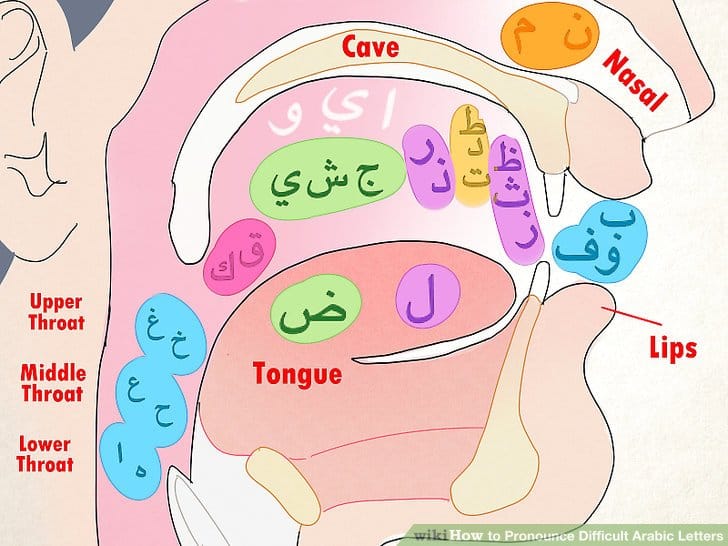
Arabic Pronunciation for Beginners: 10 Sounds English Speakers Often Find Difficult
You can learn hundreds of Arabic words and still hesitate to say them aloud.
For many beginners, pronunciation is the moment when Arabic stops feeling like something on a page and starts feeling physical. Suddenly your tongue, lips and throat have to produce sounds they may never have used consciously before.
That is completely normal.
Arabic contains several consonants that do not have exact equivalents in everyday English. Other sounds look familiar at first but are produced differently. This is why Arabic pronunciation for beginners should not be treated as a small extra at the end of a language course. It deserves attention from the beginning.
Good pronunciation is not about trying to imitate an accent perfectly. Your first goal is much simpler: learn to hear important differences, position your mouth correctly and produce sounds clearly enough that words do not become confused.
Online learning can be especially helpful because pronunciation can be practised repeatedly. You can listen, repeat, receive correction and try again without needing to rush.
Below are ten Arabic sounds that many English-speaking beginners need time to develop.
Before You Begin: Three Rules That Make Pronunciation Easier
Rule 1: Do Not Force the Sound
When learners first meet unfamiliar throat sounds, they sometimes tighten everything and push too hard.
That usually makes pronunciation worse.
The goal is controlled placement, not strain.
Rule 2: Practise the Sound Before the Word
If a letter is difficult, practise it by itself first.
Then practise it in a syllable.
Then use it in a word.
For example:
ح
حَ
حا
حال
This gradual approach is easier than repeatedly struggling through a full word.
Rule 3: Listen for Contrast
Sometimes the biggest challenge is not producing a sound but hearing how it differs from another one.
Pairs are useful.
Compare:
ه / ح
ك / ق
س / ص
ت / ط
Your ears need training as much as your mouth does.
1. ح — Ḥā’
The letter ح is one of the first sounds many English speakers notice because English does not have a direct equivalent.
It is produced in the throat with a clear breathy sound.
A common mistake is replacing it with the softer English-style h.
Compare:
ه — hā’
ح — ḥā’
Try saying:
حليب
ḥalīb
milk
Mouth-position tip
Keep your mouth relaxed and let the sound come from deeper in the throat than an ordinary English “h.”
Do not turn it into a harsh cough.
Practice drill
ḥa – ḥi – ḥu
ḥā – ḥī – ḥū
Then repeat:
ḥalīb
ḥubb
ḥāl
2. خ — Khā’
The letter خ often appears in English transliteration as kh.
Think of it as a friction sound produced toward the back of the mouth.
It is not pronounced like the “k” in kite followed by an “h.”
Try:
خبز
khubz
bread
Common beginner mistake
English speakers sometimes make the sound too weak or replace it with k.
Practice drill
kha – khi – khu
Then:
خالد
Khālid
خمس
khams
five
Keep the airflow controlled.
3. ع — ʿAyn
The letter ع is famous among Arabic learners because English does not offer an easy comparison.
It is produced in the throat and may feel unusual at first.
The mistake beginners often make is either skipping it entirely or replacing it with a vowel.
Try:
عربي
ʿarabī
Arabic
How to approach it
Do not expect perfection immediately.
First learn to notice where ع appears.
Then practise producing a gentle constriction in the throat while allowing the voice to continue.
Practice drill
ʿa – ʿi – ʿu
Try:
عمر
ʿUmar
عمل
ʿamal
work
The sound usually improves through repeated listening and correction rather than through one written explanation.
4. غ — Ghayn
غ is also produced toward the back of the mouth or throat.
It is voiced, which means your vocal cords are active.
Try:
غرفة
ghurfah
room
Useful contrast
Compare:
خ — kh
غ — gh
They are produced in a similar region, but غ is voiced.
Place your fingers lightly on your throat.
When producing غ, you should notice vibration.
Practice words
غالي
ghālī
expensive
غداً
ghadan
tomorrow
5. ق — Qāf
In careful Modern Standard Arabic pronunciation, ق is traditionally produced farther back than ك.
Compare:
ك — k
ق — q
Try:
قلم
qalam
pen
Many spoken dialects pronounce ق differently in everyday conversation, but beginners studying standard pronunciation should first learn to recognize and produce the standard sound.
Mouth-position tip
For ك, the contact is relatively forward.
For ق, the contact moves farther back.
Practice drill
ka – qa
ki – qi
ku – qu
Then:
قمر
qamar
moon
قهوة
qahwah
coffee
6. ص — Ṣād
Arabic has several consonants often described as “emphatic.”
ص is related to س, but it has a heavier quality.
Compare:
س — s
ص — ṣ
Try:
صباح
ṣabāḥ
morning
The difference affects the sound of nearby vowels as well.
Common mistake
Beginners often pronounce ص exactly like س.
Practice drill
sa – ṣa
si – ṣi
su – ṣu
Listen carefully to the heavier quality of ص.
7. ض — Ḍād
The letter ض is another emphatic consonant.
For beginners, a useful first step is recognizing that it is not simply an ordinary English d.
Try:
ضيف
ḍayf
guest
Practice contrast
د — d
ض — ḍ
Repeat:
da – ḍa
di – ḍi
du – ḍu
Focus on producing a heavier sound while keeping the tongue controlled.
You do not need to exaggerate it.
8. ط — Ṭā’
ط is the emphatic partner of ت.
Compare:
ت — t
ط — ṭ
Try:
طريق
ṭarīq
road
The ṭ sound is heavier and affects nearby vowels.
Practice drill
ta – ṭa
ti – ṭi
tu – ṭu
Then:
طالب
ṭālib
student
طويل
ṭawīl
long/tall
9. ظ — Ẓā’
ظ can be challenging because its exact spoken realization varies across dialects.
For beginners learning standard Arabic, focus on recognizing it as an emphatic consonant distinct from ذ.
Try:
ظهر
ẓuhr
noon
Practice contrast
ذ — dh
ظ — ẓ
The second should sound heavier.
Do not worry if this distinction takes time. Recognition usually develops before confident production.
10. ث — Thā’
This sound is actually familiar to English speakers because it resembles the th in think.
However, learners sometimes replace it with s or t because of influence from other languages or spoken dialects.
Try:
ثلاثة
thalāthah
three
Place the tip of your tongue lightly near or between the teeth and allow air to pass.
Practice drill
tha – thi – thu
Then:
ثوب
thawb
garment
ثقافة
thaqāfah
culture
Why Pronunciation Should Be Learned in Words, Not Only Letters
Once you can produce a sound by itself, move quickly into real vocabulary.
A sound can change slightly depending on:
- its position in a word
- surrounding vowels
- nearby consonants
- speech speed
For example, saying ق alone is different from comfortably saying:
قهوة عربية
qahwah ʿarabiyyah
Arabic coffee
That is why Arabic pronunciation for beginners should include actual speaking, not only alphabet drills.
A 10-Minute Daily Pronunciation Routine
You do not need an hour every day.
Try this:
Minutes 1–2: Listen
Choose two difficult sounds and listen carefully.
Minutes 3–4: Produce the sound alone
Repeat slowly.
Minutes 5–6: Practise syllables
For example:
qa – qi – qu
Minutes 7–8: Practise words
Use three words containing the sound.
Minutes 9–10: Say a short phrase
Put one of the words into a sentence.
This routine is short enough to repeat consistently.
Why Recording Yourself Helps
When you speak, your voice sounds different inside your own head.
Recording a short Arabic phrase lets you hear your pronunciation more objectively.
Choose one phrase.
Record it.
Listen to a correct model.
Compare the two.
Then try again.
You do not need to record long speeches.
Ten seconds is enough.
Do Not Chase an “Accent-Free” Goal
A common beginner mistake is worrying too much about sounding exactly like a native speaker.
That is not the most useful first goal.
Instead, focus on:
- clear consonants
- correct vowel length
- understandable words
- important sound distinctions
- natural improvement through listening
Accent changes gradually with exposure.
Clarity comes first.
Long and Short Vowels Matter Too
Pronunciation is not only about consonants.
Arabic distinguishes between short and long vowels.
Compare the idea of a short a sound with long ā.
Holding a vowel too long or making a long vowel too short can affect the word.
This is why learners should practise rhythm, not only individual letters.
What About Dialect Pronunciation?
Spoken Arabic varies.
A sound may be pronounced differently in Gulf Arabic, Egyptian Arabic or other dialects.
That should not discourage beginners.
Start by learning a clear standard pronunciation.
Later, when you study spoken Arabic, learn which changes are normal in the variety you are hearing.
This prevents confusion.
Three Pronunciation Habits That Slow Learners Down
Reading transliteration forever
Transliteration is useful at the beginning, but it should gradually disappear.
Your long-term goal is to see Arabic and hear the sound directly.
Avoiding difficult letters
If you always choose easy words, your pronunciation will not develop.
Work on difficult sounds regularly in small amounts.
Practising without feedback
You may repeat the same mistake without realizing it.
Guided online practice can help because a teacher can hear what you cannot hear yourself.
A Seven-Day Pronunciation Reset
Day 1
ح and ه
Day 2
خ and غ
Day 3
ع
Day 4
ق and ك
Day 5
ص and س
Day 6
ض, ط and ظ
Day 7
Review all sounds in short words and sentences.
Repeat the cycle rather than trying to “finish” pronunciation in one week.
Frequently Asked Questions
Why is Arabic pronunciation difficult for English speakers?
Some Arabic sounds are not used in ordinary English, so your mouth and ear need time to learn new movements and contrasts.
Can I learn Arabic pronunciation online?
Yes. Listening, repetition, live correction and recording yourself can all be done effectively online.
Should I learn pronunciation before vocabulary?
Learn them together. A new word is more useful when you learn how to pronounce it correctly from the beginning.
How long does it take to pronounce ع correctly?
There is no fixed timeline. Some learners adapt quickly while others need repeated listening and guided correction.
Should beginners learn MSA pronunciation or dialect pronunciation?
A clear MSA foundation is useful. Dialect pronunciation can then be introduced according to your speaking goals.
Improve Arabic Pronunciation One Sound at a Time
Strong Arabic pronunciation for beginners is not built by trying to perfect the entire language in one lesson.
It grows through small corrections.
Hear a sound.
Notice where it comes from.
Repeat it.
Use it in a real word.
Then use that word in a sentence.
When this becomes part of your regular Arabic routine, difficult letters gradually stop feeling foreign.
If you would like structured online Arabic learning from home, contact Amanah Edu Care:
Website: amanaheducare.org
Email: info@amanaheducare.org
WhatsApp/Call: +971 50 351 2636