

From Words to Sentences: A Simple Guide to Arabic Sentence Order
Introduction
Arabic can feel “hard” until someone shows you how sentences really work. The good news: most everyday sentences in Arabic follow a few simple patterns. Once you know those patterns—and practice them out loud—reading, writing, and speaking get much easier.
This guide is a friendly introduction to Arabic sentence structure for beginners. You’ll learn the two most common sentence types, see clear examples with Arabic script, transliteration, and meaning, and practice with tiny exercises you can try at home. You’ll also see how online lessons make it easy to get real-time correction and build habits you can keep.
Goal for this article: by the end, you’ll be able to read and build simple sentences with confidence—no heavy grammar, just what works.
The two big sentence types in Arabic
Arabic uses two main sentence frames you’ll meet everywhere:
- Nominal sentence (الجملة الاسمية) – starts with a noun or pronoun
- Verbal sentence (الجملة الفعلية) – starts with a verb
Think of them like two quick “templates.” Master these first; everything else becomes easier.
1) Nominal sentences: start with a noun (or pronoun)
A nominal sentence tells you what something is or describes a state. Often there is no “to be” verb in the present tense.
Pattern:
NOUN/PRONOUN + (description / information)
Examples:
- الطقسُ جميلٌ.
al-ṭaqsu jamīlun.
The weather is beautiful.
(There is no present “is” in Arabic; the meaning is understood.) - أنا طالبٌ.
anā ṭālibun.
I am a student. - المطعمُ قريبٌ.
al-maṭʿamu qarībun.
The restaurant is near.
Useful notes
- Arabic uses case endings (like ـٌ, ـُ, ـَ) in formal contexts; beginners can focus on the core words and meaning first.
- In everyday modern usage (especially speech), those endings are often not pronounced fully. That’s normal.
Build it yourself:
- البيتُ كبيرٌ. (al-baytu kabīrun.) – The house is big.
- السيارةُ جديدةٌ. (al-sayyāratu jadīdah.) – The car is new.
- أنا مشغولٌ اليوم. (anā mashghūlun al-yawm.) – I am busy today.
Try this: pick any noun you see—المقهى (the café), المدرسة (the school), المستشفى (the hospital)—and add a simple adjective: قريب (near), بعيد (far), مفتوح (open), مغلق (closed).
2) Verbal sentences: start with a verb
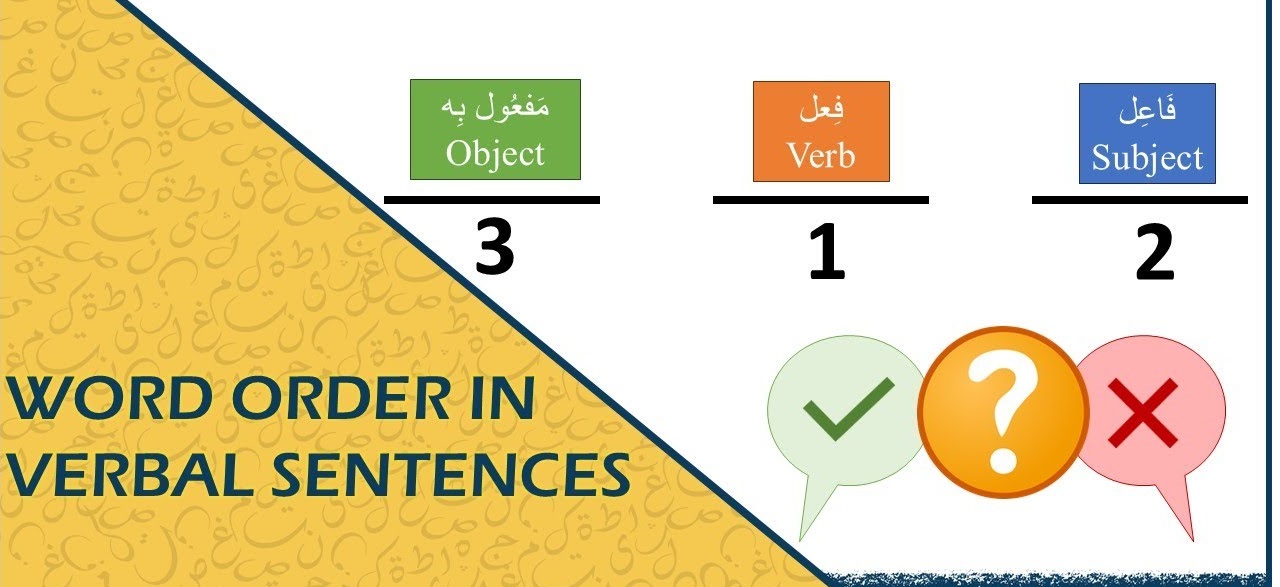
A verbal sentence tells you what happened or what is happening. The most frequent order in formal Arabic is Verb → Subject → Object (VSO). In everyday use, you’ll also meet Subject → Verb → Object (SVO), especially in speech.
Pattern (formal default):
Verb → Subject → Object
Examples (past tense):
- قرأَ الطالبُ الكتابَ.
qaraʾa al-ṭālibu al-kitāba.
The student read the book. - كتبتِ الطالبةُ الرسالةَ.
katabat al-ṭālibatu al-risālata.
The (female) student wrote the letter.
Present / imperfect examples:
- يذهبُ أحمدُ إلى المدرسةِ.
yadhhabu Aḥmadu ilā al-madrasa.
Ahmad goes to school / is going to school. - تكتبُ سارةُ تقريرًا.
taktubu Sārah taqrīran.
Sarah writes a report / is writing a report.
SVO in everyday usage:
- الطالبُ قرأَ الكتابَ. (SVO)
al-ṭālibu qaraʾa al-kitāba.
The student read the book.
(Same meaning; word order flipped.)
Beginner tip: learn both orders. Read a sentence from the first word—if it’s a verb, you’re in a verbal sentence; if it’s a noun/pronoun, think “nominal.”
Agreement made simple (beginner-friendly)
Arabic verbs and nouns “agree” in gender (masculine/feminine) and number (singular/dual/plural). Here’s a light version to start:
- With VSO (Verb first), the verb is often singular even if the subject that follows is plural:
كتبَ الطلابُ الدرسَ.
kataba al-ṭullābu al-darsa.
The students wrote the lesson. (Verb in singular masculine past; subject is plural.) - With SVO (Subject first), the verb usually matches the subject in number and gender:
الطلابُ كتبوا الدرسَ.
al-ṭullābu katabū al-darsa.
The students wrote the lesson. (Verb shows plural “-ū.”)
For beginners, you don’t need to memorize all patterns on Day 1; just notice the two common behaviors above and copy them in your practice sentences.
The “mini building blocks” you’ll use a lot
- Prepositions:
في (in), على (on), إلى (to), من (from), مع (with), عن (about), لِـ (for/to), بِـ (by/with) - Linkers & time words:
و (and), لكن (but), لأن (because), اليوم (today), غدًا/بُكرة (tomorrow), الآن (now), دائمًا (always), أحيانًا (sometimes) - Useful pronouns:
أنا (I), أنتَ/أنتِ (you m/f), هو/هي (he/she), نحن (we), أنتم/أنتنّ (you pl. m/f), هم/هن (they m/f)
Practice idea:
Take three words you know (a person, a place, a time word) and connect them with a simple verb:
- أنا أذهبُ إلى المتجرِ اليوم.
anā adhhabu ilā al-matjari al-yawm.
I go to the store today.
English vs Arabic word order (quick glance)
| Meaning | English | Formal Arabic (common) | Everyday Arabic (also heard) |
| The student read the book | S + V + O | قرأَ الطالبُ الكتابَ (V + S + O) | الطالبُ قرأَ الكتابَ (S + V + O) |
| Sarah writes a report | S + V + O | تكتبُ سارةُ تقريرًا (V + S + O) | سارةُ تكتبُ تقريرًا (S + V + O) |
| The café is open | S + “is” + Adj | المقهى مفتوحٌ (Nominal) | same in speech, endings often light |
No need to force one order—exposure to both helps you understand more of what you read and hear.
Present vs past vs future (ultra-light view)
Arabic uses patterns to show time. A beginner path that works:
- Past: فعلَ forms (e.g., كتبَ kataba “he wrote”).
- Present/ongoing: يفعلُ forms (e.g., يكتبُ yaktubu “he writes / is writing”).
- Future: Add سـ or سوف before the present (e.g., سيكتبُ sayaktubu “he will write”).
Practice:
- اليوم أكتبُ رسالةً. – Today I write/am writing a letter.
- أمس كتبتُ رسالةً. – Yesterday I wrote a letter.
- غدًا سأكتبُ رسالةً. – Tomorrow I will write a letter.
Mini practice sets (with answers)
A) Turn words into a nominal sentence
Words: المدرسة (the school), بعيدة (far)
Your sentence: _______________________________
Answer: المدرسةُ بعيدةٌ. (al-madrasa(tu) baʿīdah.) – The school is far.
B) Build a verbal sentence (VSO)
Words: قرأَ (read), الولدُ (the boy), القصةَ (the story)
Your sentence: _______________________________
Answer: قرأَ الولدُ القصةَ. (qaraʾa al-waladu al-qiṣṣata.)
C) Flip to SVO
Your sentence: _______________________________
Answer: الولدُ قرأَ القصةَ. (al-waladu qaraʾa al-qiṣṣata.)
D) Replace the subject (she)
Use هي with the present tense of “write” (تكتب):
Sentence: هي تكتبُ رسالةً. – She is writing a letter.
Read each answer aloud twice. If possible, record a voice note and compare your pronunciation next day.
Common beginner slips (and quick fixes)
- Starting every sentence with a subject:
Try a few verb-first sentences each day. Variety improves comprehension. - Skipping vowels completely:
Stretch ā, ī, ū clearly. Long vowels carry meaning and clarity. - Over-formal in casual chats:
It’s fine. Foundations come first. Over time, you’ll pick up everyday phrasing. - Fear of mistakes:
Small, frequent practice wins. One short sentence said out loud beats 20 silently “understood.”
A two-week starter plan you can keep
Week 1 (10–15 min/day)
- Day 1–2: Nominal sentences (noun + description)
- Day 3–4: VSO sentences in past tense
- Day 5–6: Flip VSO → SVO for the same idea
- Day 7: Review + read 5 sentences aloud
Week 2 (10–15 min/day)
- Day 8–9: Present tense (I/you/he/she)
- Day 10: Future with سـ (sa-)
- Day 11: Add prepositions (في، إلى، مع)
- Day 12–13: Build 6 mixed sentences (nominal + verbal)
- Day 14: Read everything aloud; record and re-listen
Keep a small notebook: one page per day with 3–5 sentences. Re-read yesterday’s page before you add today’s.
How online lessons make it easier
- Live correction: a tutor hears your sentence and fixes word order on the spot.
- Shared screen & whiteboard: color-code verbs/subjects/objects so the pattern “sticks.”
- Voice-note routine: send short recordings on off-days; get quick feedback.
- Flexible timing: easier to keep a habit when lessons fit your real life.
- Low pressure: speaking from home reduces anxiety, especially for kids and new learners.
How Amanah Edu Care helps (online-only)
Amanah Edu Care is an online educational institute. Our Arabic lessons focus on real sentences you’ll use, not just rules. Learners can choose one-to-one or small groups, work with native tutors used to teaching non-native speakers, and follow flexible schedules that suit UAE families and professionals. The aim is steady progress—understanding patterns, saying them out loud, and feeling confident using Arabic every day.
Call to Action
Ready to turn words into confident Arabic sentences?
Amanah Edu Care offers online Arabic lessons for kids, teens, and adults across the UAE—practical, sentence-focused learning with native tutors and flexible timings.
📌 Website: amanaheducare.org
📩 Email: info@amanaheducare.org
📞 WhatsApp/Call: +971 50 351 2636
Start today and build sentences that work—in real life.